Monday, June 18, 2007

Nearing the End

"If danger be now, why then it is not to come. There's a predestinate providence in the fall of a sparrow."

This passage alludes to the Bible, Matthew 10.20: "Are not two sparrows sold for a farthing, and one of them shall not fall on the ground without your Father?" Meaning God has a plan for the least of us that we cannot escape.

As always, Q1 is short by comparison to F and Q2. But this, to me, is a particularly good example of where the brevity of Q1 enhances the impact because it is more readily understood in performance, especially by those unfamiliar with the play. If Shakespeare is meant to be performed not read, as Tim's old high school English teacher said, then the above is more accessible and impacting in performance than:
"Not a whit, we defy augury: there's a special
providence in the fall of a sparrow. If it be now,
'tis not to come; if it be not to come, it will be
now; if it be not now, yet it will come: the
readiness is all: since no man has aught of what he
leaves, what is't to leave betimes?"

Long or short, it is sweet text that hurts the heart in much the same way that Hamlet himself describes when he learns of the duel: "Believe me, Horatio, my heart is on the sudden very sore all here about."

And still, he rejects ‘augury,’ any attempt to read the tea leaves in order to take steps accordingly and instead accepts his destiny.

He knows, from the beginning when the Ghost appears to him, that he must, eventually, confront the King -- "oh cursed spite that ever I was born to set it right" -- and that it will cost him his life. Now he realizes the time is upon him.

With this line, Hamlet's restless anxiety of “to be or not to be” gives way to a “let be” of God’s plan. (Or is it Satan's? Does it matter? One doesn't exist without the other). And in this final, heartbreaking giving up/giving in there resides finally, paradoxically, also the resolve to act.

Saturday, June 16, 2007

Q&A with Tim Sheridan

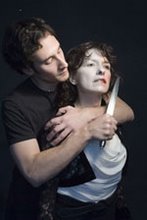
In 2003, Tim Sheridan produced and played Horatio in a production of the First Quarto Hamlet, directed by Andrew Borba, at Theatre of NOTE in Los Angeles. The production dramaturg was Kathleen Irace, editor of the version we're using. Details and some photos of the production were outlined in Hamlet: The Texts of 1603 and 1623 (Arden Shakespeare: Third Series) -- "They chose an intimate indoor set, furnished like a library, they dressed the actors in vaguely Victorian or Edwardian costumes, and they cast a woman as Hamlet." Tim was kind enough to give us some further, pretty illuminating, insight into his production:

1) Why did you decide to cast a woman as Hamlet? What were you exploring?
Not surprisingly, we get this question all the time. It's a two-part answer: The very bland truth is that Alina Phelan came to the audition and blew the roof off the place. She was the best actor who auditioned for the role, and therefore won it! Usually, people are disappointed by this answer, as they expect we had some sort of important message in casting a woman; if there is a message, I suppose it's that, when producing a text such as this that has been neglected or overlooked - we have an even greater responsibility to present it in the best light possible! She was the best, and we wouldn't settle for less. That's the first part; now the second: There was an interesting byproduct to Alina's casting. I, in my arrogance, had expected that doing the Q1 text was more than enough to get people to the theater. The director, Andrew Borba, was much smarter. He knew that we needed to play up in the press the fact that we had cast a woman - just to show people (who were mostly ignorant of Q1) that we were doing something different and exciting that was worth their time. Once we had them in the theater, then we could excite them about the text!

2) How did you decide upon the indoor library setting and the "vaguely Victorian or Edwardian costumes"?
I wish I could claim credit, but again these were the brilliant ideas of our director and our terrific production staff. The important thing about the library is that it was in a state of massive decay. On one very practical level, the set was meant to symbolize the erosion of the state in the play. We basically took a cue from Hamlet's unflattering descriptions of Denmark, his uncle, in comparison to Denmark, his father, and then brought that to the physical world of the piece. On another level, this was in keeping with the main theme of the production, which was that we were creating new life inside something very old, very established and, to a large extent, run-down (referring to Hamlet in general). Wardrobe has always been the easiest way to convey chronological setting. We felt it was important to set the production somewhere in the past - and we agonized for much of the pre-production and then even into rehearsals over when to set it. We wanted to be careful not to look like we were making political or historical arguments and/or judgments, which unfortunately you so often see in Shakespeare productions. Some people seem to think that since they're in the public domain, these texts are their own personal blank canvases; those productions invariably end up imposing a logic upon the text that Shakespeare did not intend and which, therefore, works against the true merits of the play. If you want to know how to produce Shakespeare, simply take Hamlet's advice to the players and keep it simple and honest. Back to the wardrobe: one of our main goals was for our audiences to walk away thinking of Q1 as a perfectly viable and playable text. We thought we'd play upon the common prejudice that "good" and "legitimate" Shakespeare is regal and heavily costumed. We wanted the audience to know that we were taking this very seriously and that, therefore, they ought to as well; hence, the Victorian/Edwardian wardrobe. That sort of consideration isn't something you see a lot of in L.A. Shakespeare, and I assume it's why ended up being nominated for Best Costumes at that year's Ovation Awards (L.A.'s "equivalent" to the Tonys.)

3) You had a fascinating beginning to the play. How did you arrive at using the First Player performing the Pyrrhus speech as the context for announcing old Hamlet's death ("presumably") to Hamlet?
I was totally against it! And I was totally wrong! Remember that our goal was to show people right away that this text was not what they were accustomed to. Andrew knew that the opening scene (and every scene with Marcellus!) was too similar to the Q2 and Folio versions to get that message across right from the start. So he concocted that "moment before" which opened every show and showed the audience that they were about to see something they'd never seen before. All I can say is that I was very lucky to have found Andrew Borba - the guy's a genius.

4) I was intrigued by Rob Kendt's calling the production "found-art 'outsider' Shakespeare, as richly revealing as any post-modernist deconstruction." Inasmuch as you understand at all what he meant, could you elaborate on/take a stab at this?
Isn't that a great quote? What I especially love is that he completely got what we were going for without any coaching or program notes. Success! We produced Q1 in 2003, on the 400th anniversary of its publication. Yet very few (even Shakespeare lovers) knew of its existence! This was a great experiment; we were confident the text was playable as written, but we would never truly know until we actually did it. Then when it all started coming together, though we had been confident, we couldn't help but enjoy feeling like we had uncovered something special. Many folks who came to see the show have told me they experienced the same rush I had felt years before when I, quite accidentally, happened upon Q1 in the Florida State University library - "Wow! What is this that I've stumbled upon??" It's virtually impossible to get that kind of rush from a 400 year old text, and I think Kendt was verbalizing the excitement we were all feeling!

5) Why did you decide to cut the Ghost's appearance in the closet scene? And to have Hamlet speak the lines instead?
Well, this is a terrific illustration of why I should never direct. Throughout the production, I (along with our amazing and gracious dramaturg, Kathi Irace) was the champion of the text "as written." If I had been in charge creatively, we would've ended up with a live version of the play exactly "as written," which would've been very authentic, very structured and VERY BORING! Andrew came in and right away said "Tim, I'm going to direct Hamlet. Period." I told him he had my total support as long as he didn't alter a word of the Q1 text. He completely agreed and it was as simple as that. As far as this particular scene, Andrew always tried to keep us remembering that, in a lot of ways, Hamlet is a ghost story - and it therefore be scary! I think we felt that a guy onstage looking 'ghostly' (especially after having already seen him twice) was less freaky than if young Hamlet became possessed by Old Hamlet right in front of the audience. I mean - it's like 'The Exorcist' - how scary is that? Wish you'd seen it. Still gives me chills.

6) How long was your run and how would you describe your audience response to the Q1 version?
We were limited to a twelve-week run, like most Shakespeare shows in L.A., but we knew that going in. Obviously, we had a terrific response from the Shakespeare literati, as evidenced by our inclusion in the new Arden edition! As far as the general audience, I think Rob Kendt's quote totally embodies the response. Things I heard were that people enjoyed the production, were thrilled to have "discovered" the text, and most of all, to have seen the entire Hamlet story in under two hours!! Who wouldn't love that?

7) What was your own response trajectory from your first encounter with this version to the end of the run?
When I stumbled across the text, I knew it was good, it was playable and that I would produce it. But then, I'm pretty stubborn. I have to say, though, that nothing prepared me for the rehearsal process and, ultimately, the run of the show, where I and our entire company came to believe in and fall in love with Q1 more and more every night. It's one thing to understand something intellectually and quite another to experience it viscerally. My old high school English teacher was the first to tell me that Shakespeare is meant to be acted, not read. This becomes especially significant when dealing with a largely unknown text and is why I am so thrilled to know that you are involved in a Q1 production! The work isn't done yet; some of us on the inside get it, but there's still a world of audiences out there who are unfamiliar with Q1 and those who are familiar with it know it as the "bad quarto." It's up to us to change their minds!

Thursday, June 14, 2007

GO SEE LIVING DEAD IN DENMARK!!!! -- no really... go see it!

I saw it last night. It got a standing ovation -- how often does that happen other than on Broadway where it's just a hohum habit!? Well, here it was well deserved. The acting is excellent across the board, the fight choreography is thrilling and the play and production are what anyone who has ever complained of the moribund state of American theater is looking for. No geezer theater that's better done on film or TV here. And like the comic books it emulates, Vampire Cowboys' theater has a cult following. How cool is that! (And Jason is like totally rock 'n roll - make that punk - happenin' with his studded leather wrist cuffs, bad-ass moves and wide-ranged Ghost-ninja-zombie-Hamlet portrayal, and yes, I'm biased -- he is my son after all -- but it's still true.)

Tuesday, June 12, 2007

GO SEE LIVING DEAD IN DENMARK!!!!

Enough of this drab- and dreariness... sheesh!

Let's talk zombies, instead...

Son o' mine, Jason Liebman - our very own Hamlet - is starring as
zombie Hamlet in the sequel to our show... the most excellent
Vampire Cowboys' Living Dead in Denmark by Qui Nguyen.


4 nights only beginning tonight:
June 12th thru 15th, 2007 (tues, wed, thurs, fri @ 8pm)
at THE BECKETT THEATRE ROW STUDIOS
(410 W. 42nd Street)

Part of the National Asian American Theatre Festival.

Click here for details.

Sunday, June 10, 2007

Rainer Maria Rilke - Duino Elegies (First Elegy)

Who, if I screamed, would hear me among the ranks
of angels? and even supposing one clutched
me suddenly to its heart: I would perish from the
power of its presence. For beauty is nothing
but the beginning of a terror we can hardly bear,
and it amazes us so, because it nonchalantly declines
to destroy us. Every angel is terrifying.
And so I restrain myself and choke back the call
of my dark wailing. Oh, who can we turn to
in our need? Not angels, not men,
and the perceptive beasts already sense
that we are not very secure or at home
in the interpreted world. We are left with perhaps
some tree on the mountainside, that we see again
each day; we are left with yesterday's street
and the perverse loyalty of a habit,
that liked us so much that it stayed and never left.

Oh and the night, the night, when the wind full of space
sucks at our face - for whom would it not stay,
deceptive, difficult for the solitary heart
to confront. Is it any easier for lovers?
Ah, they only conceal their fates in each other.

Don't you know yet? Hurl the emptiness from your arms
out to the spaces we breathe; perhaps the birds
will respond to the expanded air with more fervent flight.

...

Still, it is peculiar to inhabit the Earth no longer,
to no more practice barely-learned customs,
for roses and other especially auspicious things
to have no significance for a human future;
what one was in endlessly anxious hands,
to be no more, and to leave behind
even one's own name like a broken toy.
Peculiar, to no longer desire one's desires. Peculiar,
to see everything related to one's self
floating off into space. And being dead is laborious
and full of catching up, before one gradually senses
a trace of eternity - yet the living always
make the mistake of drawing too-sharp distinctions.
Angels (they say) often don't know, whether they pass among
the living or the dead. The eternal torrent
sweeps through both realms carrying all ages
with it and drowns them out in both.

In the end the early departed have no longer
need of us. One is gently weaned from things
of this world as a child outgrows the need
of its mother's breast. But we who have need
of those great mysteries, we for whom grief is
so often the source of spiritual growth,
could we exist without them?
Is the legend vain that tells of music's beginning
in the midst of the mourning for Linos?
the daring first sounds of song piercing
the barren numbness, and how in that stunned space
an almost godlike youth suddenly left forever,
and the emptiness felt for the first time
those harmonious vibrations which now enrapture
and comfort and help us.

Saturday, June 9, 2007

Truth, Beauty and Ofelia's Death

These are the intertwining recurring themes in the play (as Chan lays out so well):
  • Our tendency to artificially beautify reality in order to conceal the truth.
  • Our tendency to be false to others because of our failure in being true to ourselves.
  • Our lack of honesty in facing up to the truth, the most fundamental one being that we are going to die; and
  • Death itself - mortality and how we humans (fail to) deal with it.

Shakespeare makes that last two points overtly right at the beginning:

But you must think your father lost a father,
That father dead, lost his, and so shall be
Until the general ending.
Therefore cease laments, it is a fault
‘Gainst heaven, fault ‘gainst the dead, a fault ‘gainst nature,
And in reasons common course most certain,
None lives on earth, but he is born to die.

But nowhere in the play does he interlace the themes so completely as in Gertred's description of Ofelia's drowning. It's actually pretty funny: I doubt there has been anyone who has taken a closer look at that monologue and didn't think, "Oh for chrissakes people, don't just stand there and watch her... somebody jump in and save her!!" And I used to write this off as "Shakespearean" or poetic license or with some such dismissiveness. Wrong.

Here's a thought: How 'bout entertaining the notion that Shakespeare knew exactly what he was doing and meant it as morbidly stinging commentary. Here is the Quarto version, which is even less florid than the Folio. Read it with the four bullet points above in mind:

O my lord, the young Ofelia,
Having made a garland of sundry sorts of flowers,
Sitting upon a willow by a brook,
The envious spring broke. Into the brook she fell,
And for awhile her clothes, spread wide abroad,
Bore the young lady up, and there she sat
Smiling, even mermaid-like 'twixt heaven and earth,
Chanting old sundry tunes, uncapable as it were
Of her distress. But long it could not be
Till that her clothes, being heavy with their drink.
Dragged the sweet wretch to death.

Wednesday, June 6, 2007

Hic et Ubique

Our director, Cynthia, accuses me of too much magical thinking. And she's right, by god. Though I would quibble with "too much" and might remind her that SHE's the one who cast me as Gertrude and the Ghost. Besides, how boring the world if you believe it is made up of only what our 5 measly senses can perceive and rationalize. Even Einstein knew, "there are more things in heaven and earth, Horatio, than are dreamt of in your philosophy."

So wrap your head around this one: Since she and I pushed this second production of our Q1H into being, both our fathers have died. Mine was "estranged" -- a teenaged dad who could never figure out what his only child represented in his life ("oh, you know, when kids marry," was all Horst Schäfer could ever muster to my, "what happened with you and mom?") -- so more of a mind-bender than a heart-render (the dad who raised me died in '95). But, what's it all about, Alfie? Don't worry, Cynthia, I won't dwell there. I realize, "It hath made me mad," enough as it is. But even you find this one... trippy.